
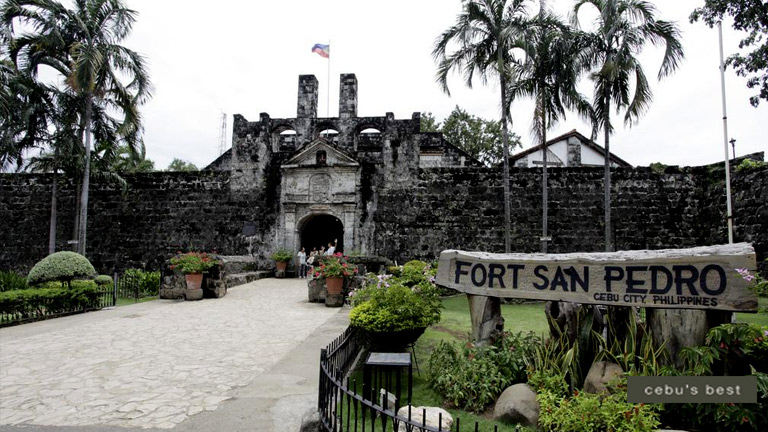
Fuerte de San Pedro is a military defense structure in Cebu (Philippines), built by the Spanish under the command of Miguel López de Legazpi, first governor of the Captaincy General of the Philippines. It is located in the area now called Plaza Indepedencia, in the pier area of the city. The original fort was made of wood and built after the arrival of Legazpi and his expedition. In the early 17th century a stone fort was built to repel Muslim raiders. Today’s structure dates from 1738 and is the oldest triangular bastion fort in the country. It served as the nucleus of the first Spanish settlement in the Philippines. During the Philippine Revolution at the end of the 19th century, it was attacked and taken by Filipino revolutionaries, who used it as a stronghold. The fort is triangular in shape, with two sides facing the sea and the third side fronting the land. The two sides facing the sea were defended with artillery and the front with a strong palisade made of wood. The three bastions are named La Concepción (SW); Ignacio de Loyola (SE), and San Miguel (NE). It has a total inside area of 2,025 square metres (21,800 sq ft). The walls are 6.1 metres high by 2.4 metres thick (20 feet high by 8 feet thick), and the towers are 9.1 metres (30 ft) high from the ground level. The circumference is 380 metres (1,248 ft). The sides are of unequal lengths and the one fronting the city is where one may find entry into the fort. Fourteen cannons were mounted in their emplacements most of which are still there today. Work first started in 1565 with Miguel Lopéz de Legazpi breaking ground. The date of construction of the stone fort is uncertain, although there are claims that a Jesuit Antonio Campioni built a stone fort in 1630, and the gate of the fort bears the date 1738 together with the arms of Castile and Leon. It is certain, however, that the fort underwent major renovations in the late 19th century as part of a building program to improve Cebu. Today, part of the fort is a museum that displays legacies of the Spanish government and well-preserved Spanish artifacts like documents, paintings, and sculptures. The large lawn of the fort is now being used for functions like weddings, birthdays, and other occasions. But certain permits and requirements should be approved first by the designated personnel.

 TravelBuddy